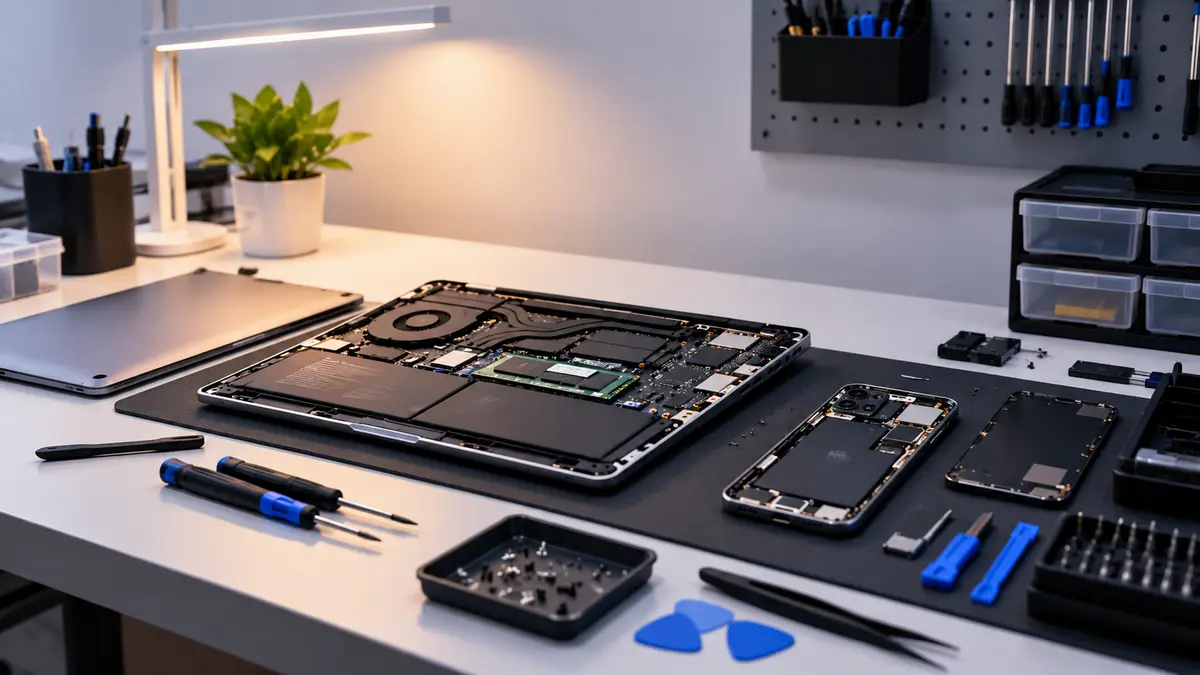
Laptop repair in Nepal is confusing and often unfair. Prices vary, fake parts look real, and most people don't know who to trust.
This guide fixes that. It covers costs, authorized vs local shops, parts availability, common scams, and simple checklists - everything you need before, during, and after a repair.
Whether your screen is cracked, battery is dead, or laptop won't turn on — this guide helps you decide smartly.
Let's get into it.
How Laptop Repair Works in Nepal?
Most Nepali repair shops follow a standard process: you bring in (or request) your laptop, the technician diagnoses the problem (often with no charge), and then provides a written estimate. You approve the quote, they order any needed parts or begin the fix, then test the laptop and hand it back. Both authorized centers (brand-specific service centers) and local shops operate, plus freelancers or door-step technicians. Authorized centers handle warranty work and major parts (often replacing displays/batteries with new units), while local shops do most multi-brand fixes. Customers should always back up data before handing over the laptop. In practice, basic fixes (software issues, cleaning, minor parts) can be done in a few hours to a day, whereas major repairs (like motherboard or screen replacement) may take several days due to parts ordering.
Laptop Repair Cost in Nepal (2026)
Understanding local pricing prevents sticker shock. According to Nepali repair guides, typical Kathmandu costs are: battery replacement ~NPR 2,000–6,000; screen replacement ~NPR 3,000–12,000. Other common repairs fall in similar ranges. The table below summarizes rough 2026 price ranges and expected repair times (Kathmandu market):
Repair Type
Price Range (NPR)
Time
Screen Replacement
3,000 - 12,000
1 - 2 hours
Battery Replacement
2,000 - 6,000
30 minutes
Keyboard Replacement
1,500 - 4,000
1 hour
Motherboard Repair
5,000 - 20,000
3 - 7 days
Charging port/jack
500 - 1,500
20 minutes
Overheat cleaning
500 - 1500
30 minutes
Notes: Prices vary by brand/model and repair difficulty.
Authorized vs Local Repair Centers in Nepal
Authorized Centers (Brand Service)
Pros: Genuine parts and official expertise. Repairs are done by technicians trained for that brand. Comes with manufacturer warranty on parts/repair. Usually reliable quality.
Cons: Higher cost for labor and parts, and often limited to specific models/brands. Service centers typically only handle in-warranty or high-end devices; out-of-warranty work may still be expensive. They sometimes simply replace the entire unit or module (e.g. swap boards) rather than do fine repairs.
When to Use: If your laptop is under warranty or it’s a high-end device, go authorized. Use them for major issues (like motherboard or GPU faults) to ensure correct fix. Also ideal when you need a valid warranty paper for insurance or resale.
Local Shops (Unofficial Repair)
Pros: Cheaper prices and flexible service. Can fix almost any brand/model and often perform board-level work that authorized centers won’t. Fast turnaround for minor fixes. Multi-lingual and informal – you can negotiate.
Cons: No official warranty (you must trust the shop’s promise). They may use lower-grade, aftermarket or even used parts. Quality varies a lot. If a part fails, many shops will try to blame the customer. Overcharging or part-swapping is a risk if you are not careful.
When to Use: For out-of-warranty repairs where cost matters more than official warranty. Good for simple fixes (like a new keyboard, fan cleaning, reapplying thermal paste). Also useful in cities without an authorized center. Always choose a well-reviewed local tech and insist on a receipt.
Price Difference
Authorized centers typically charge 10–30% more than local shops for the same repair, because they use OEM parts and official labor rates. For example, an HP battery might cost ~NPR 5,000 at an authorized HP center vs ~NPR 4,000 at a local shop (plus labor).
Warranty Difference
Authorized service usually provides an official warranty (often 6–12 months) on parts and labor. Local shops sometimes give a short-term “service warranty” (commonly 1–3 months) on the repair they perform, but this is informal. Always ask for written warranty terms. Remember, warranty from a local shop has no force with the laptop manufacturer.
Which to Choose (Decision Guide)
Check Warranty Status: If your laptop is still under manufacturer warranty (with ticket number or barcode), an authorized center is required or you risk voiding the warranty.
Cost vs Benefit: If repair cost approaches half the price of a new similar laptop, consider buying new. For older machines (3+ years), local repair might not be worth it unless you’re on a tight budget.
Urgency and Trust: For critical business/life-device repairs, authorized centers and verified home technicians give more accountability (some Nepali advice notes “users prefer verified and professional platforms instead of unknown shops”). For quick, inexpensive fixes (e.g. fan cleaning, OS install), a trusted local shop is fine.
Parts Availability: If parts for your brand are scarce in Nepal (see next section), weigh that factor – sometimes waiting for a rare part is impractical. In that case, a good local repair might be better than waiting weeks for an official fix.