Intel vs AMD: The Story Behind the Processors Inside Your Laptop
When you open a laptop, you probably don't think much about the tiny chip sitting inside it. You might simply see a name like:
Intel Core 5
or
AMD Ryzen 5
and ask:
Which one is better?
But behind those names is a story that goes back more than 50 years.
The processors we use today are the result of decades of competition, engineering, failures, breakthroughs, and some very small pieces of silicon. So before we compare Intel and AMD, let's understand where this competition actually started
It Started With Something Much Smaller Than a Laptop
In the late 1960s, computers were very different from the ones we know today. Computers were large, expensive machines. The idea of putting a complete computer processor onto a tiny piece of silicon was still relatively new.
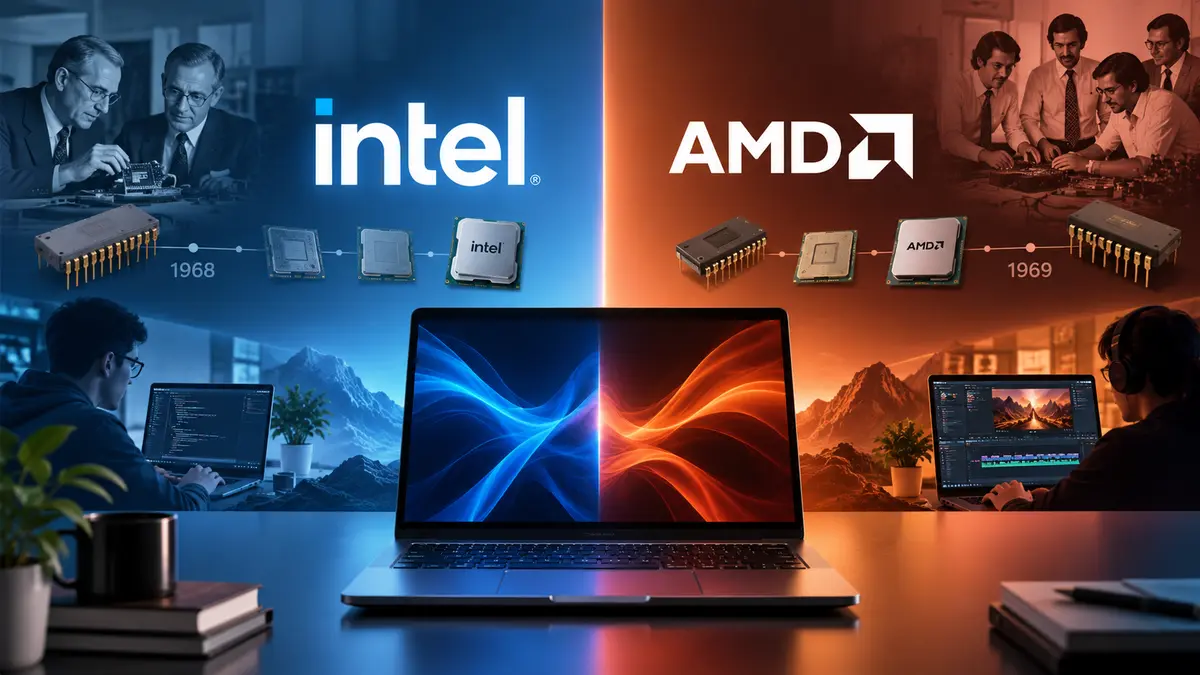
Then, in 1968, two engineers named Robert Noyce and Gordon Moore founded a new company in Silicon Valley. They called it Intel. At the beginning, Intel wasn't primarily a laptop CPU company. Its early focus was on semiconductor memory and developing new semiconductor technologies.
Just one year later, another company appeared.
In 1969, Jerry Sanders and seven other co-founders established Advanced Micro Devices — AMD in Silicon Valley. At this point, neither company looked anything like the Intel and AMD we know today. They were semiconductor companies trying to find their place in a rapidly developing industry.
Then Came a Calculator
Here's where the story gets interesting. In 1969, a Japanese calculator company called Busicom approached Intel. They wanted Intel to create a collection of chips for a new calculator. The original idea involved 12 custom chips. But Intel engineer Ted Hoff looked at the problem differently. Instead of building many chips with fixed functions, Intel engineers proposed a smaller system that included a programmable general-purpose processor. That processor became the Intel 4004.
In November 1971, Intel officially announced the 4004 as a commercially available general-purpose microprocessor. It contained about 2,300 transistors. That number sounds tiny compared with modern processors, but the idea was revolutionary. Instead of building a different piece of hardware for every function, you could have a programmable chip that could perform different tasks through software.
And that idea helped set the direction for modern computing.
Meanwhile, AMD Was Taking a Different Path
AMD was also growing as a semiconductor company. In the early years, AMD worked across semiconductor products rather than immediately becoming the direct CPU competitor we know today. An important chapter came in 1976, when Intel and AMD entered into a patent cross-licensing agreement.
Then, in 1982, the companies entered a technology agreement that allowed AMD to serve as a second source for certain Intel microprocessor products. This is an important part of the story because AMD and Intel were not always direct rivals in the way people think of them today.
There was a period when AMD was producing processors compatible with Intel's technology under licensing arrangements.
The PC Revolution Changed Everything
Then personal computers started becoming increasingly important. IBM's first PC, introduced in 1981, used an Intel 8088 processor. Intel went on to produce generations including the 286, 386, 486 and eventually the Pentium. These processors became part of the x86 family. And x86 became extremely important because software could be developed around the architecture and continue working across generations of compatible processors. This created a huge opportunity. And AMD wanted a bigger piece of it.
AMD Becomes a Serious CPU Competitor
AMD produced its own x86-compatible processors, including the Am386, introduced in 1991. The Am386 became an important product for AMD and contributed significantly to the company's processor business during the early 1990s. AMD later introduced the K5, followed by the K6.
The K5 had difficulties competing against Intel's products, and AMD itself described it as a transitional product. But AMD's next generation, the K6, was intended to compete directly with Intel's sixth-generation processors.
The competition was becoming much more serious.
Then Came Athlon
AMD eventually developed a reputation for producing competitive processors that challenged Intel's position in the PC market. One important chapter was the Athlon era.
AMD continued pushing CPU performance, while Intel continued developing its own architectures. This competition mattered to consumers because it meant PC manufacturers had another major processor supplier to consider.
Instead of one company defining the entire market, there were two major competitors pushing each other forward.
The Battle Changed Again
Over the years, the processor industry became much more complicated. It wasn't simply about: "Who has the highest clock speed?"
Companies began focusing on:
More CPU cores
Better efficiency
Smaller manufacturing processes
Better integrated graphics
Lower power consumption
Better laptop battery life
Multithreading
Specialized hardware
The definition of a "fast processor" was changing.
And eventually, AMD made another major move.
AMD Ryzen Arrives
In 2017, AMD introduced its Ryzen family. Ryzen became an important part of AMD's modern comeback in consumer processors.
Instead of simply trying to compete on clock speed, AMD focused heavily on multi-core performance, efficiency and overall platform performance.
Ryzen processors eventually appeared across:
Desktop PCs
Laptops
Gaming systems
Workstations
Servers
And the word Ryzen became familiar to laptop buyers.
Intel Wasn't Standing Still
Intel continued developing its own processors and architectures.
For years, laptop buyers became familiar with names such as:
Core i3
Core i5
Core i7
Core i9
These became common ways of describing different performance tiers.
More recently, Intel introduced the Core Ultra family, bringing new platform capabilities including dedicated NPU hardware for supported AI workloads.
And Now We Have AI
The story has now entered another chapter. Modern laptops aren't only about CPU performance anymore.
They can have three different types of processing hardware:
CPU → General computing
GPU → Graphics and parallel workloads
NPU → Certain AI workloads
Intel's Core Ultra processors and AMD's Ryzen AI processors are examples of this newer direction. AMD's Ryzen AI family combines CPU, GPU and dedicated NPU capabilities for supported AI workloads.
So the processors inside today's laptops are doing much more than the tiny chips of the 1970s.
So... Intel or AMD?
After all that history, you might expect us to finally say:
"Intel is better."
or
"AMD is better."
But that's not really how it works.
Both companies have spent decades developing different processor families for different types of users.
Today, you can find:
Intel
Core 3 → Core 5 → Core 7
and
Core Ultra 5 → Core Ultra 7 → Core Ultra 9
AMD
Ryzen 3 → Ryzen 5 → Ryzen 7 → Ryzen 9
and
Ryzen AI 5 → Ryzen AI 7 → Ryzen AI 9
But here's the important part:
The number doesn't tell the whole story.
A newer Ryzen 5 isn't necessarily comparable to an older Ryzen 5.
The same is true for Intel.
Think About It Like Cars
Here's an easy way to understand it.
Imagine two cars:
Car A: 2026 model, 1.5L engine
Car B: 2018 model, 2.0L engine
Can you say the 2.0L car is automatically faster? Not necessarily.
The engine design, transmission, weight, efficiency and many other factors matter.
Laptop processors are similar.
Don't simply say:
Core 7 > Ryzen 5
or
Ryzen 7 > Core 5
Instead, compare the actual processor models.
What Should You Look At When Buying a Laptop?
Instead of asking only Intel or AMD, look at the whole laptop.
1. Processor
What exact CPU is being used?
2. Generation
How new is the processor?
3. Cores & Threads
How much processing capacity does it provide?
4. RAM
8GB may be enough for basic use, while 16GB or more can be useful for heavier workloads.
5. SSD
A fast SSD can make a major difference to everyday responsiveness.
6. GPU
Especially important for gaming, video editing and 3D applications.
7. Battery
A processor's efficiency matters, but the laptop's battery capacity and overall design matter too.
8. Display & Build
A laptop isn't just a processor. You're going to spend your time using the keyboard, screen, touchpad and battery.
9. Price
Finally, compare what you're actually getting for your money.
The Interesting Part About Intel vs AMD
The most interesting thing about Intel and AMD isn't really who is better.
It's that their competition has helped drive the development of personal computing for decades.
From a tiny 2,300-transistor Intel 4004 designed around a calculator in the early 1970s to today's processors containing vastly more sophisticated architectures and specialized hardware, the basic idea has remained surprisingly consistent:
Put more computing power into a smaller, more efficient package.
And that journey is still continuing.